
Reporting repairs in Edinburgh: what’s urgent and when to use Fixflo
Immediate danger, fire or a suspected gas leak? Do not wait for a Fixflo reply. Read the emergency advice below
Albany Lettings | Tenant repairs
Know who to contact and what to report.
When something goes wrong in your Edinburgh rental, the next step should be clear. Here is how to report a repair, recognise an urgent problem and use Fixflo.
Guidance reviewed:
A repair report helps us understand what has happened and decide what needs to happen next. But a maintenance form is never a substitute for emergency help.
This guide covers urgent repairs, routine maintenance, what to include in your report and the steps that follow. It is for tenants whose property is managed by Albany. Where your landlord manages the property directly, use the repair contact details supplied for your tenancy.
Emergency help comes first
Deal with any immediate risk before taking photographs or completing an online report. Once you are safe and have contacted the appropriate emergency service, let Albany know.
Fire or immediate danger to life
Call 999. For a fire in your home, leave if you can do so safely and do not re-enter. If you cannot get out safely, tell the emergency operator and follow their instructions.
Gas smell or a carbon monoxide alarm sounding
Move to a safe place in the fresh air and call the National Gas Emergency Service on 0800 111 999. Do not use flames or operate electrical switches. Do not delay the call to submit a Fixflo report.
If someone has collapsed or is seriously unwell, call 999 for medical help. Do not assume a sounding carbon monoxide alarm is simply faulty.
Follow SGN’s gas emergency advice and carbon monoxide guidance.
A power cut affecting the wider area
Call 105 to reach the electricity network operator, or follow SP Energy Networks’ power-cut advice. Tell Albany if the problem appears to be inside your property or creates an additional safety concern.
Which repairs need urgent attention?
Contact us promptly when a fault could make the home unsafe, leave essential facilities unusable or cause serious damage. Examples include:
- Uncontrolled leaks or flooding: especially water reaching ceilings, wiring, sockets or neighbouring properties.
- Loss of heating or hot water: explain the weather conditions, whether any safe alternative is available and whether anyone in the household is particularly at risk.
- Electrical failure within the property: including a total loss of power or signs of an unsafe electrical fault.
- A failed external lock: where a door or window cannot be secured.
- Faulty smoke, heat or carbon monoxide alarms: a fault needs prompt attention. An alarm warning of fire or carbon monoxide needs the emergency action above.
Record the problem on Fixflo when it is safe, and phone Albany on 0131 229 3999 during office hours. Do not wait to finish the form if urgent help is needed.
If the office is closed
Use the out-of-hours emergency contacts provided for your tenancy. An online report or office voicemail is not a substitute for speaking to the emergency contact when the situation cannot safely wait.
Keep those details somewhere accessible before you need them. If you cannot find them, ask Albany to resend them during office hours.
Stay away from water near electrics. Only turn off the water at the stop valve if you know how and can reach it safely. Do not dismantle boilers, work on wiring or attempt repairs that put you at risk. Read Electrical Safety First’s flood advice.
What is a non-urgent repair?
A routine repair still needs reporting. The difference is that it does not currently create a safety risk, remove an essential facility or threaten significant damage.
Examples may include a dripping tap, a small contained leak away from electrics, a loose internal fitting or one radiator underperforming while the home remains adequately heated. An internal handle is not routine if it could trap someone or prevent safe escape.
Use Fixflo to record the issue as soon as you notice it. Do not wait for a routine inspection. If a leak spreads, a fitting becomes unsafe or a service stops working completely, update the report and contact us again.
Damp and mould: report it promptly
Damp and mould should not automatically be labelled non-urgent simply because there is no visible leak. The extent of the problem, the rooms affected and the people living there all matter.
Tell us where it is, how much there is and whether it is spreading or returning. Include photographs where safe and explain any effect on your household. You do not need to provide medical proof to report a concern.
Scotland’s rules change on 6 October 2026
New damp and mould duties take effect on that date for most private tenancies, including Private Residential Tenancies. For cases covered by the new rules, landlords must normally investigate within 10 working days, send written findings within 3 working days of completing the investigation, and begin necessary safety repairs within 5 working days of completing it.
These are not deadlines for completing every repair. Cases reported before 6 October are not subject to the new timeframes, but existing repair duties still apply. Do not wait until October to report a problem.
Read the Scottish Government’s tenant guidance on Awaab’s Law, including the scope of the rules and provisions for delays beyond a landlord’s control.
When should you use Fixflo?
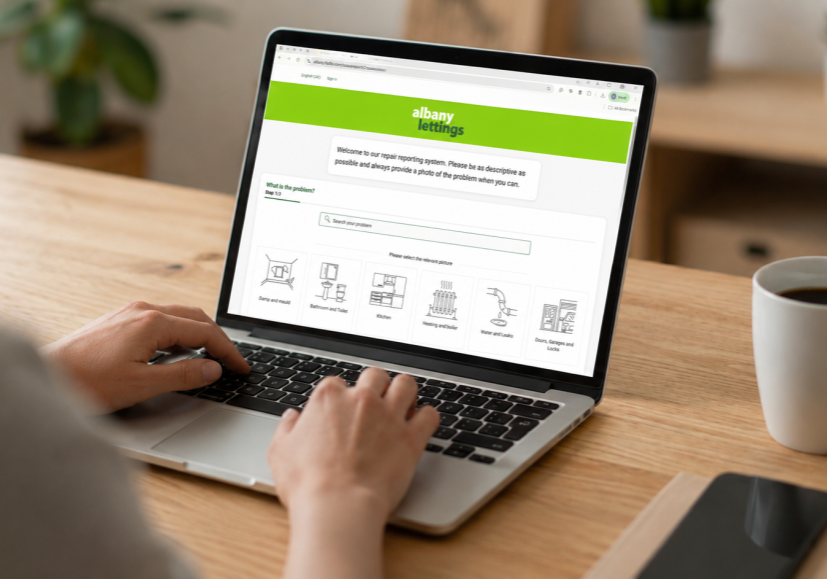
Albany’s Fixflo repair portal is the usual route for reporting maintenance. It lets you describe the problem, add photographs and keep the report together rather than relying on scattered messages.
You can submit an issue at any time of day. Being able to submit a report 24 hours a day does not mean every report receives an immediate response. Use the emergency services or your tenancy’s emergency contact when urgent action is needed.
Use the questions and guidance in the portal to describe the problem as accurately as you can. For an existing repair, keep the reference and follow the update instructions you receive. If the situation worsens, explain what has changed.
If you cannot access Fixflo or need help using it, contact Albany so we can help you report the issue. Do not leave a repair unreported because you are unable to use the form.
What happens after you report a repair?
Make safety the first priority
Take the emergency action above where necessary. For an ordinary repair, note what has happened and what is affected.
Submit the details
Use Fixflo to describe the issue. Add photographs or a short video where the portal allows and it is safe to do so.
Follow up urgent issues by phone
Call the office during opening hours, or use the emergency contact supplied for your tenancy outside those hours.
The report is assessed
Albany reviews the information and may ask for further details or arrange an inspection to understand what work is needed.
The next action is arranged
Where a contractor is required, the work and access arrangements are coordinated. Some faults need an initial visit before the repair can be completed.
Keep in touch until it is resolved
Look out for messages about the repair and respond to requests for access or information. Contact Albany with your reference if an update is overdue or the problem returns.
Repair times depend on the problem and its risks. Acknowledging a report is not the same as confirming a visit or completing the work. Scottish landlords must meet the repair standards for private rented homes; this guide does not replace those duties.
What to include in your repair report
You do not need to diagnose the fault. A clear description of what you can see, hear or smell is more useful than a guess about which part needs replacing.
- The location: your property address, the room and the affected fitting or appliance.
- The problem: what is not working and whether other services are affected.
- The timing: when it started, whether it is continuous and whether it is getting worse.
- Useful evidence: a wider photograph, a close-up and any visible error message. Never take risks to obtain them.
- The impact: any safety concern or reason the household needs extra support.
- Contact and access details: a current telephone number and anything we need to know to arrange a visit.
Do not delay reporting because you cannot provide every detail. The important thing is to tell us there is a problem.
Not sure how to describe the problem?
Tell us what has happened and how it is affecting your home. Fixflo will guide you through the report, and our team can help with the next step. For immediate danger, use the emergency advice above first.